Explainer · tokenmaxxing
What is tokenmaxxing?
Definition
Tokenmaxxing is treating how many AI tokens a person or team consumes as the measure of how well they use AI — maximising usage, sometimes on internal token leaderboards, instead of measuring what the tokens bought.
Where it comes from
When a company wants people to adopt AI, token usage is the easiest number to count: it is on every provider’s bill and every usage dashboard. Rank people by it, and a cost becomes a score.
The “-maxxing” is internet slang for pushing one number as high as it will go, whatever it costs everything else. That is exactly the problem.
Tokenmaxxing isn’t a strategy
Tokens are an input, not an output. At scale, more tokens don’t mean more shipped. A metric that rewards consumption rewards the expensive way to do everything: longer contexts, more retries, agent loops that keep going after they stop helping, and work that gets thrown away.
It is the old rule about measures that become targets. Once the number is the goal, it stops telling you anything — and it hides the only question that matters: what did this piece of work cost, and was it worth it?
What to do instead
Treat tokens as a scarce resource — priced per piece of work, budgeted, and spent on purpose. The FinOps Foundation calls the discipline token economics. In practice it comes down to a few shifts:
- Measure cost per piece of delivered work, not tokens per person per month.
- Start work on purpose. Spend should begin because someone asked for an outcome.
- Stop loops that stop helping. A retry that makes no progress is pure cost.
- Set limits that stop, not reports that explain the bill afterwards.
- Tie spend to an outcome: did the change merge, pass review and pass its checks?
Where Ticinuum fits
How Ticinuum fits: spend tokens on purpose.
Ticinuum measures every piece of work its agents do — tokens, priced at your provider’s published rates — and lets you cap that spend for the whole organization, for a project, team or person, and for a single run.
-
A price on every piece of work
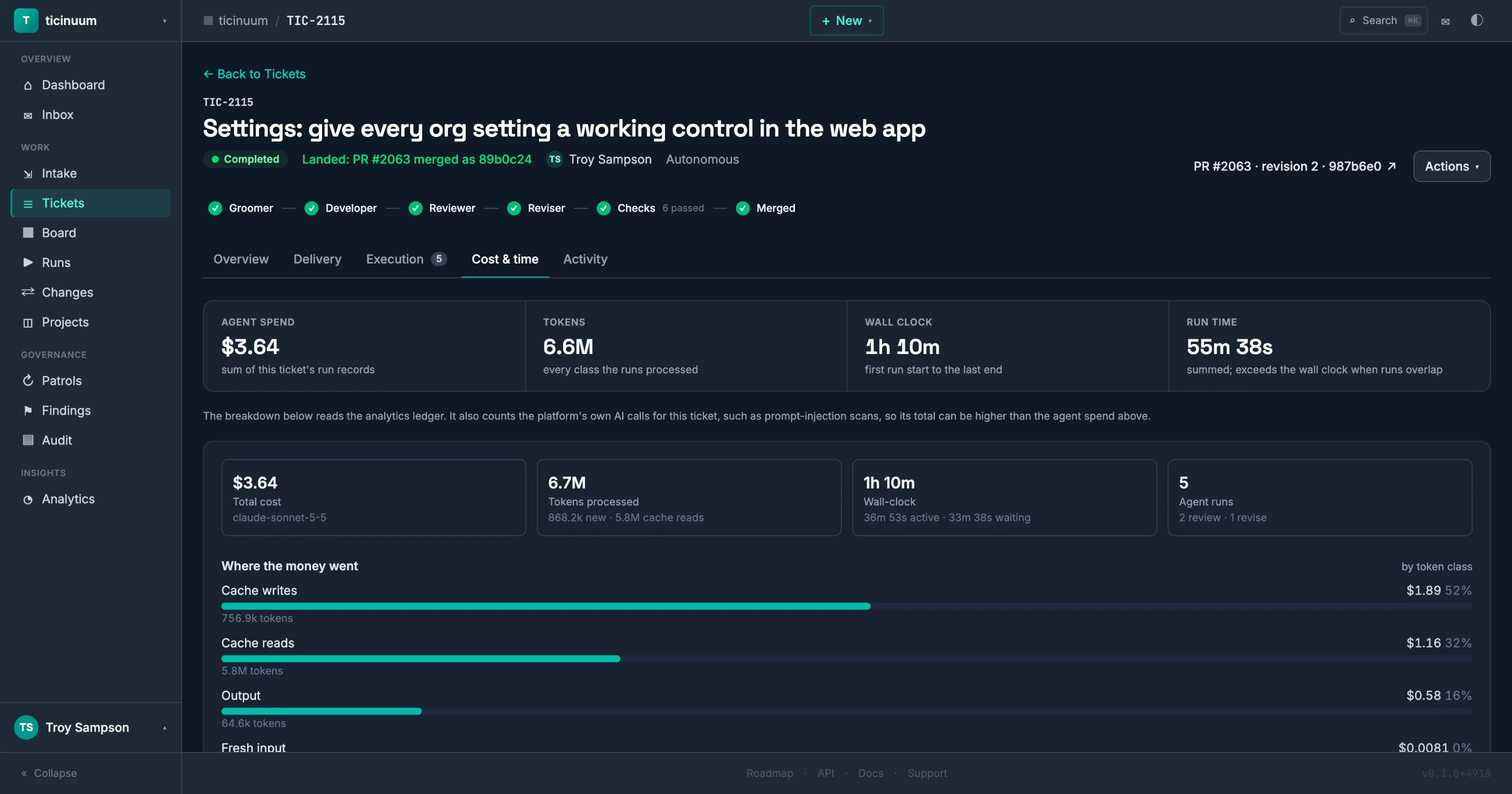
Each ticket carries its own tokens, by model and by token class, priced at your provider’s published API rates. (A run on a Claude subscription is recorded at $0 and shows its tokens.)
Cost controls → -
No build starts until someone asks
Filing a ticket never starts the build. A person presses Run, or a rule your organization chose starts it. (An under-specified ticket still gets a short grooming run when it is filed.)
What starts work → -
Loops that stop paying when they stop helping
The review-and-revise loop keeps going only while each round makes progress, and hands a stall to a person. Tool-calling rounds and plan sizes are capped, so nothing spins forever.
The review loop → -
Limits that stop, not reports that explain
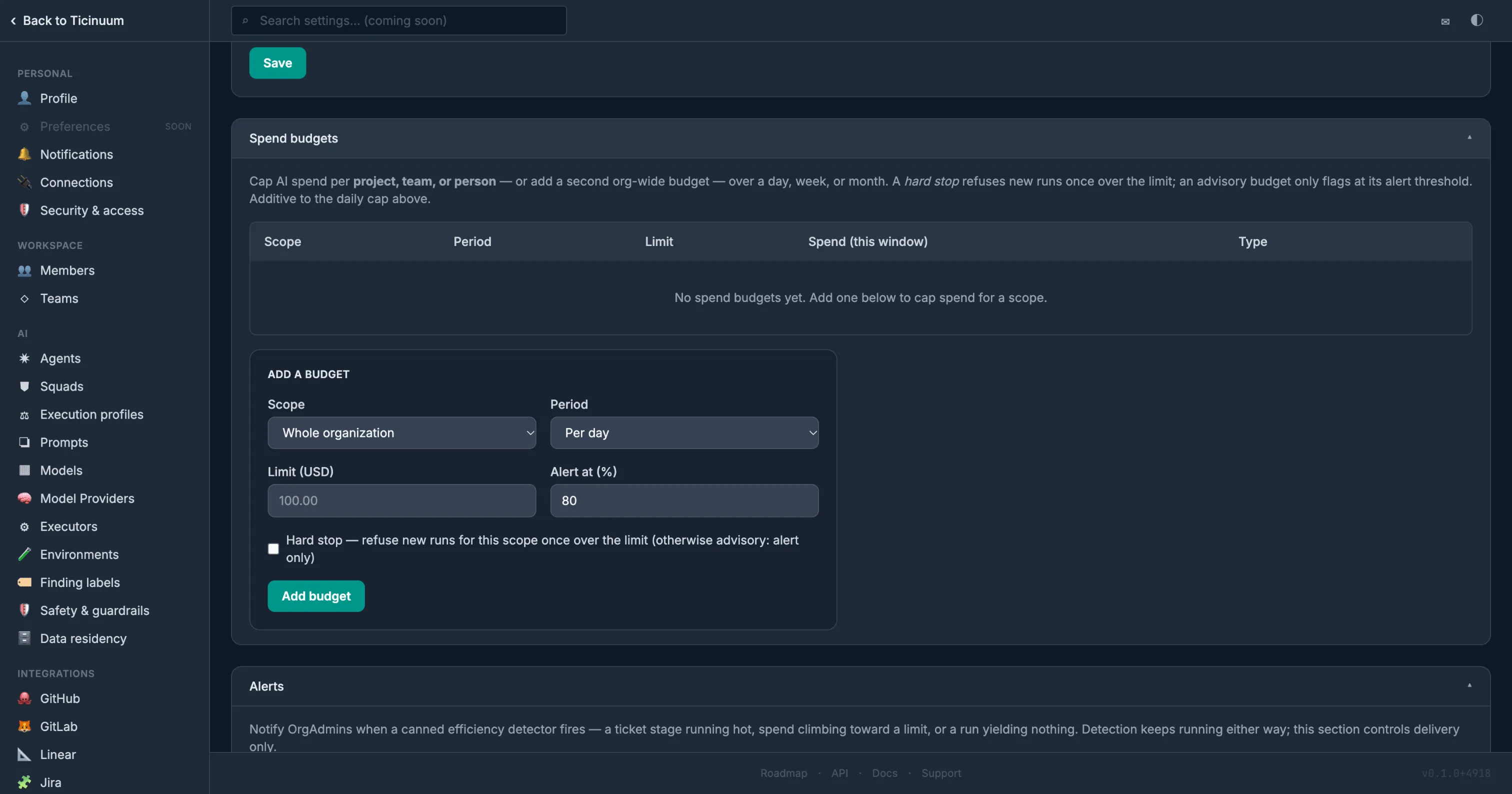
A daily budget breaker in dollars pauses the organization’s new work at its cap and fails closed. Budgets per project, team or person can refuse new runs, and per-run token, spend and time ceilings pause a run for a person.
Budgets and ceilings → -
Spend beside what it bought
A ticket’s cost sits next to what it delivered — its pull request, the review’s verdict and the checks — and a Truth view lists any ticket marked done whose code never landed.
The record →
- 1h 10m
- request to merged
- 5
- agent runs
- $3.64
- model usage at published API rates
- 2
- broken tests caught before merge
One real ticket from Ticinuum’s own backlog, TIC-2115 (October 18, 2026) — not an average. Its dollars are the runs’ tokens priced at Anthropic’s published API rates. The merge was the platform’s because Ticinuum’s own organization lets the agent merge; by default a person does.
In the product
Captured from the product.
Real screens from Ticinuum’s own organization, taken in October 2026 — not mockups.
Said plainly
What Ticinuum doesn’t do here.
- Dollar figures are tokens priced at your provider’s published API rates — a measured cost, not your invoice.
- A run on a Claude subscription is recorded at $0, so the daily breaker and the per-run dollar ceiling don’t see it; there the CLI’s own per-run budget and turn limits stand in.
- Efficiency alerts and spend stewardship are built but not yet validated in use. Don’t rely on them yet.
- Ticinuum doesn’t quote a price before a run.
FAQ
Tokenmaxxing: questions, answered plainly.
Is heavy AI usage a bad sign, then?
No — using AI heavily isn’t the problem; making usage the goal is. A usage number can tell you whether people are trying the tools at all. As a target it rewards spend over outcomes, and the teams that come out ahead measure what the tokens bought.
What should we measure instead of tokens per person?
Cost per piece of delivered work, and whether it was delivered: merged, reviewed, checks passed. That is the shift from tokenmaxxing to token economics — tokens metered, attributed to the work they were spent on, and tied to an outcome.
How do you stop agents running away with my bill?
Independent layers. No build starts until someone asks for it. A global kill switch and a per-org daily budget breaker in real dollars — it auto-pauses the org on breach and fails closed — stop new work from starting, and budgets per project, team or person can refuse new runs at their own limits. Configurable per-run ceilings on tokens, dollars and time pause a single run before it balloons (a run on a Claude subscription is recorded at $0, so neither the breaker nor the dollar ceiling sees it — there the CLI’s own per-run budget and turn limits stand in), and the review loop stops the moment a round stops making progress. And an operator hard-stop cancels a run already in flight, cutting the model call within seconds.
Keep reading
The ideas behind Ticinuum.
Put your backlog on the continuum.
From intent to PR to review — one durable, auditable continuum of work. Join the early-access waitlist.