Explainer · agentic engineering
What is agentic engineering?
Definition
Agentic engineering is building software with AI agents that do the engineering work themselves — plan a change, build it, test it and review it — inside a system that holds them to the discipline of a good engineering team: a written brief, independent review, tests that gate the merge, a budget, and a person’s sign-off where it matters.
How it differs from AI-assisted coding
In AI-assisted coding — autocomplete, a chat pane in the editor — a person drives and the model suggests. The person still writes, reads and ships every line, so the work moves at the speed of that person.
In agentic engineering the agent takes a whole piece of work and comes back with a finished change: a pull request that has been built, tested and reviewed. The person’s job moves from typing the code to deciding what gets built, setting the bar it has to clear, and saying yes.
It is also not “vibe coding” — prompting a model and accepting whatever comes back. The word engineering is the point: the output is held to the same standard as a careful team’s, and somebody can show how.
Code got cheap. Shipping it well didn’t.
An agent can write a change in minutes. Without a system around it, you are left choosing between two bad options: slow every agent down to the speed of a person reading diffs, or let the agents run and find out later what they cost, what they broke and who said yes.
Neither scales. The first throws away what made the agents worth having; the second trades speed for risk nobody signed up for.
What an agentic engineering practice needs
The practices that make engineering reliable are old and well understood. They slow people down, which is why teams skip them under pressure. Agents don’t get tired of them — if something enforces them:
- A written brief specific enough for a machine to act on and a person to audit.
- Independent review — the agent that wrote the change is not the one that checks it.
- Tests and CI that gate the merge, not a summary that says the tests probably pass.
- A budget with limits that stop, not a dashboard that explains the bill afterwards.
- A person’s sign-off where policy says so, and a clear record of who gave it.
- A record of what was asked, what was done, what it cost and who approved it.
Where Ticinuum fits
How Ticinuum fits: an agentic engineering platform.
Ticinuum’s own agents take engineering work from ticket to merged code, and the practices above are built into the path of the work — so they take minutes, and they happen every time, not when someone remembers. Budgets, policy and a tamper-evident record govern every step.
-
A brief before any build
A request becomes a structured brief before any code is written. Filing a ticket never starts the build: a person presses Run, or a rule your organization chose starts it.
How it works → -
A second agent checks the first
The reviewer is always a fresh agent in a fresh context, never the coder. The review-and-revise loop keeps going only while each round makes progress, and hands a stall to a person.
Review and approval → -
Merge on green, and a person’s yes by default
Nothing merges without an affirmative review and your repository’s checks. By default a person makes the final merge; letting the agent merge is a separate choice your organization makes on the record.
Human-in-the-loop → -
A budget that stops
A measured cost on every ticket, a daily budget breaker per organization that fails closed, budgets per project, team or person, and per-run ceilings that pause a run for a person.
Cost controls → -
A record you can show someone
Each state change and its event are written in one database transaction, and sensitive changes land in a hash-chained audit stream re-verified every day. Tamper-evident, not immutable.
Audit trail → -
On your own model account
Agents run on your own model credential — an Anthropic API key, a Claude subscription or AWS Bedrock — so model spend lands on your provider account with no markup.
Security →
- ~1,070
- pull requests merged into Ticinuum, Oct 18 – Nov 8, 2026
- 86%
- opened by Ticinuum’s own agents
- 3 in 4
- landed by the platform itself
Ticinuum builds Ticinuum. These counts are from its own repository, and its own organization has turned on automatic starts and letting the agent merge — both ship off for everyone else, where a person presses Run and a person makes the final merge.
In the product
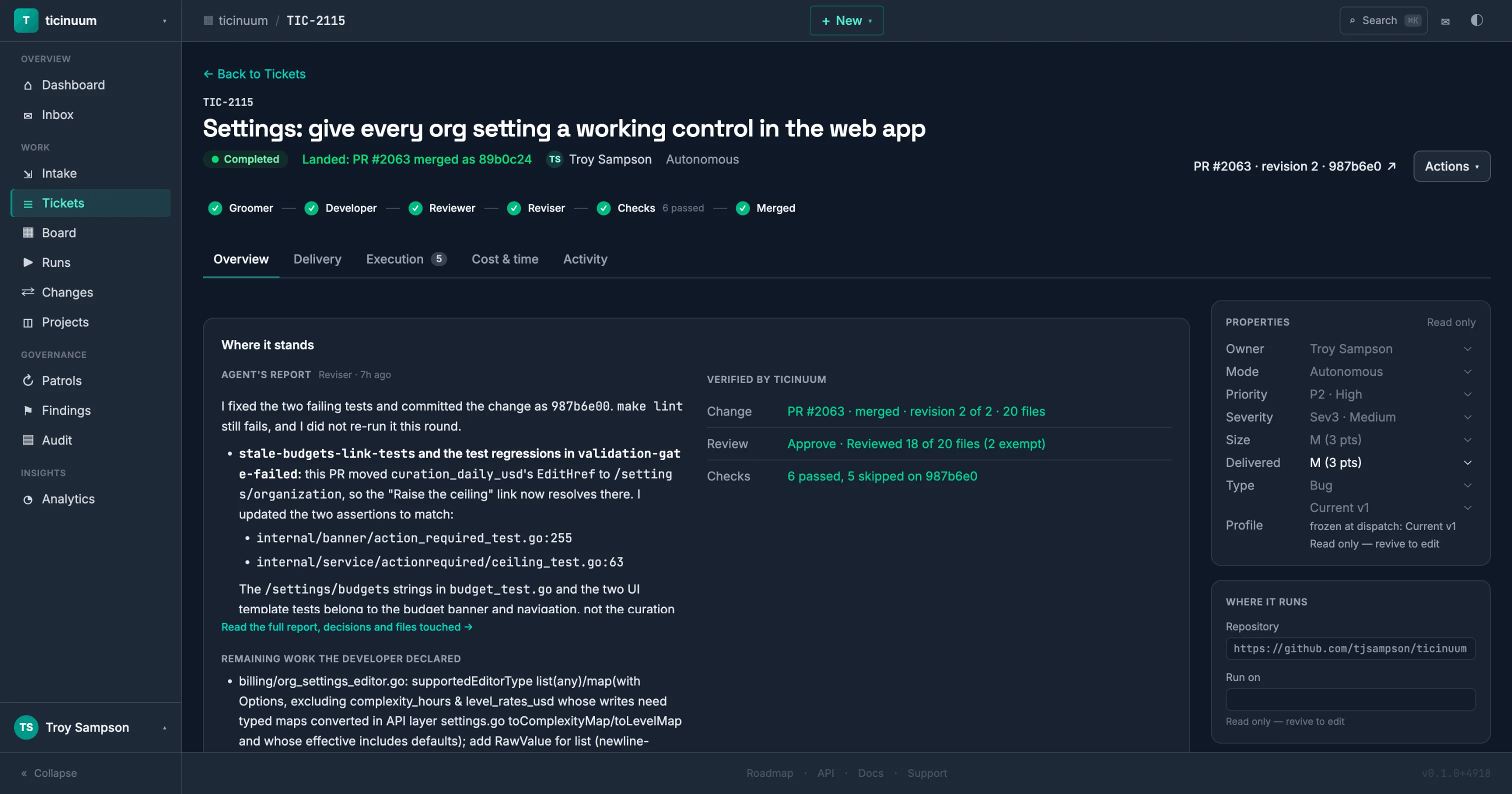
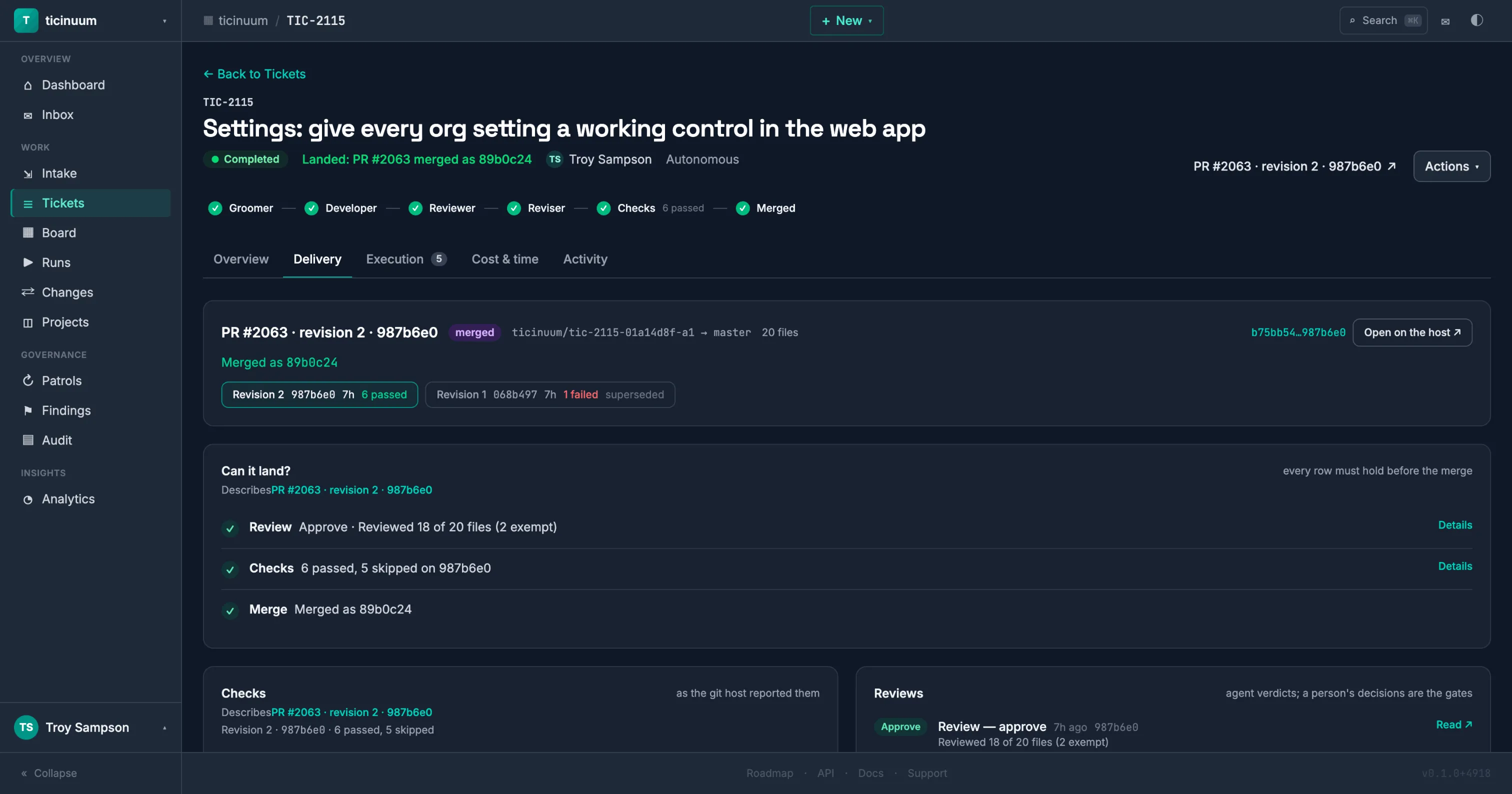
Captured from the product.
Real screens from Ticinuum’s own organization, taken in October 2026 — not mockups.
Said plainly
What Ticinuum doesn’t do here.
- Ticinuum is pre-launch: nothing is for sale yet.
- It runs a closed delivery loop — ticket to a green main branch. It does not watch your software in production after it ships, and it does not learn from outcomes on its own.
- It runs its own agents. Putting other companies’ coding agents under the same limits and approvals is the plan, not the product.
- It holds no security certification (no SOC 2).
FAQ
Agentic engineering: questions, answered plainly.
Is agentic engineering the same as vibe coding?
No. Vibe coding is prompting a model and accepting what comes back. Agentic engineering keeps the agent doing the work but holds the result to an engineering standard — a written brief, independent review, tests that gate the merge, a budget and a sign-off — and keeps a record that shows it.
What is an agentic engineering platform?
Software that runs agents through the whole delivery of a change and enforces the practices around them, rather than helping one person type faster. Coding assistants help a person write code. Ticinuum delivers the work, and governs it.
Where do people fit in?
People decide what gets built, set the bar it has to clear, and — by default — make the final merge. An agent that needs a decision asks a person, and — unless it named a harmless default up front — waits for the answer instead of guessing. What changes is where their time goes: less re-reading diffs, more of the decisions only a person should make.
Does it run my backlog unattended?
Not unless you choose it. By default a person starts each piece of work: filing a ticket grooms it if it needs it (a short paid run), then it waits until someone presses Run. From that one click an autonomous ticket goes through review to an approved, green PR with no further click — gated by the kill switch, the budget breaker and injection quarantine, held to your org's executor capacity, and never touching a quarantined or on-hold ticket — and then a person merges it. Supervised tickets also wait for a person to promote them. Work no person started — a ticket an agent files, a ticket a finished one unblocks, and a pull loop that starts your backlog's top-ranked work under a work-in-progress limit — all wait until a platform admin exposes it and your org admin opts in against a recorded disclosure of what it does and spends. (Patrols your admin schedules, the next steps of a plan a person started, and the unfinished remainder of a ticket a person ran — at most three in a chain — run on their own.) Issues from your tracker or git host land in Intake as requests, and nothing happens until a person admits them.
Is the review actually independent?
The reviewer is always a fresh agent in a fresh context — never the coder. Before its model weighs in, the build and test commands your repository declares run on a real checkout, and a red result blocks the change automatically; Ticinuum doesn't guess your toolchain, so with nothing declared it leaves that to your pull request's own CI, which the merge waits on anyway. It can post under a distinct identity; if you don't connect a separate reviewer identity, it falls back to the coder's identity and labels the verdict as a comment — we're upfront about that. On GitHub it withdraws its own earlier change request once a later review passes.
Keep reading
The ideas behind Ticinuum.
Put your backlog on the continuum.
From intent to PR to review — one durable, auditable continuum of work. Join the early-access waitlist.