Cost controls for AI coding agents.
Tokenmaxxing isn't a strategy. Ticinuum prices every piece of work an agent does from real usage, and lets you cap that spend for the whole organization, for a project, team or person, and for a single run. No build starts until someone asks for it.
Early access ↓AI cost controls
Autonomy you can afford.
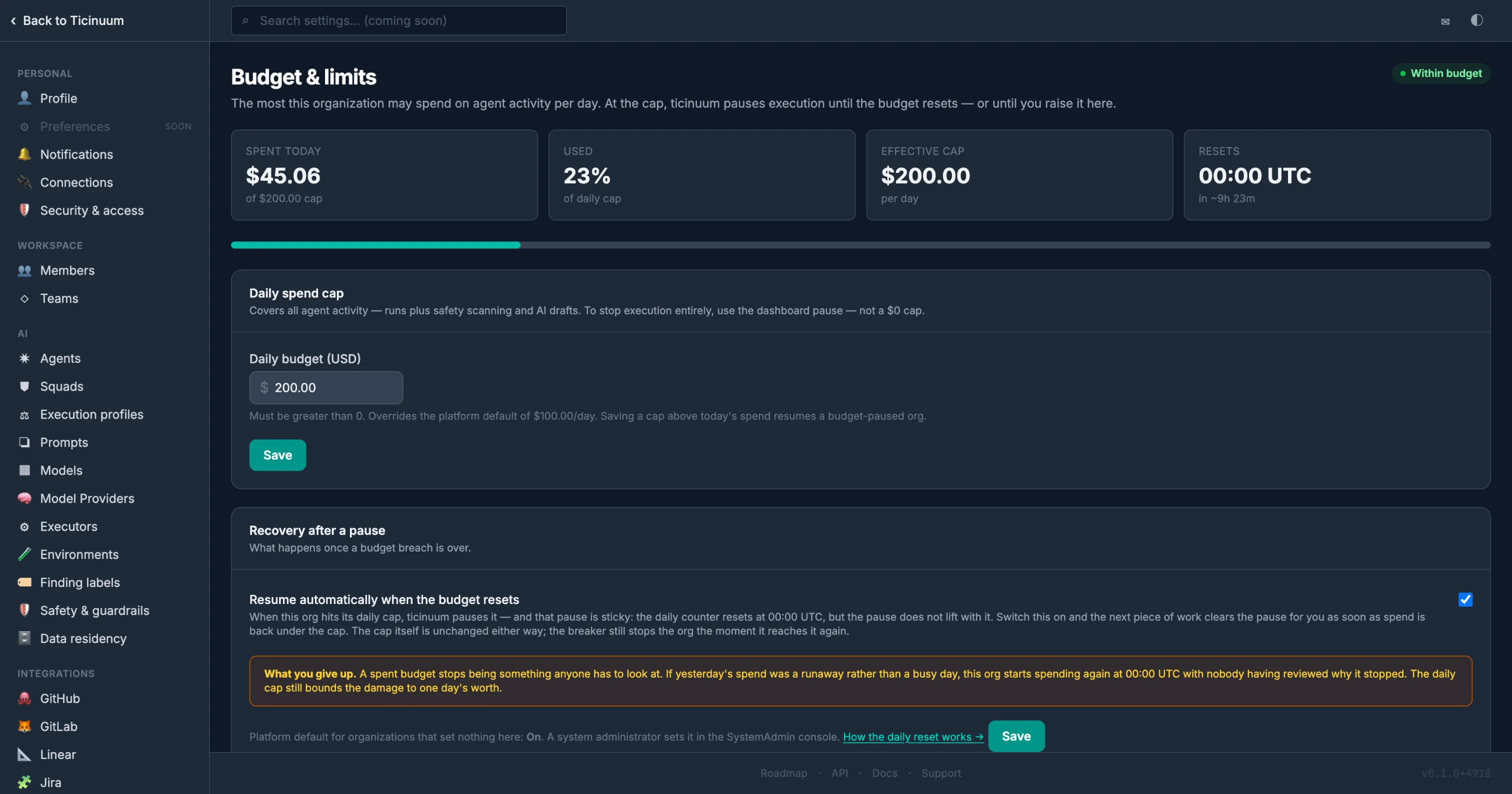
Every org gets a daily budget breaker in real dollars, and no build starts until someone asks for it. Cross the breaker and Ticinuum auto-pauses the whole org until an operator resumes it. And it fails closed: if the system can't verify spend is safe, it refuses to run.
Where the system cannot verify that spend is safe, it fails closed — it refuses to run rather than burn money it cannot account for.
- No build starts until someone asks — filing, promoting, releasing or approving a ticket moves it to open and starts nothing. A build starts when a person presses Run, a patrol your admin scheduled fires, a plan a person started releases its next step, or your org has opted in to a ranked pull of the backlog under a work-in-progress limit. (An under-specified ticket still gets a short grooming run when it is filed.)
- Global kill switch — refuse every new run, platform-wide, the moment it flips. It stops work from starting; to stop a run already in flight, use the hard-stop below.
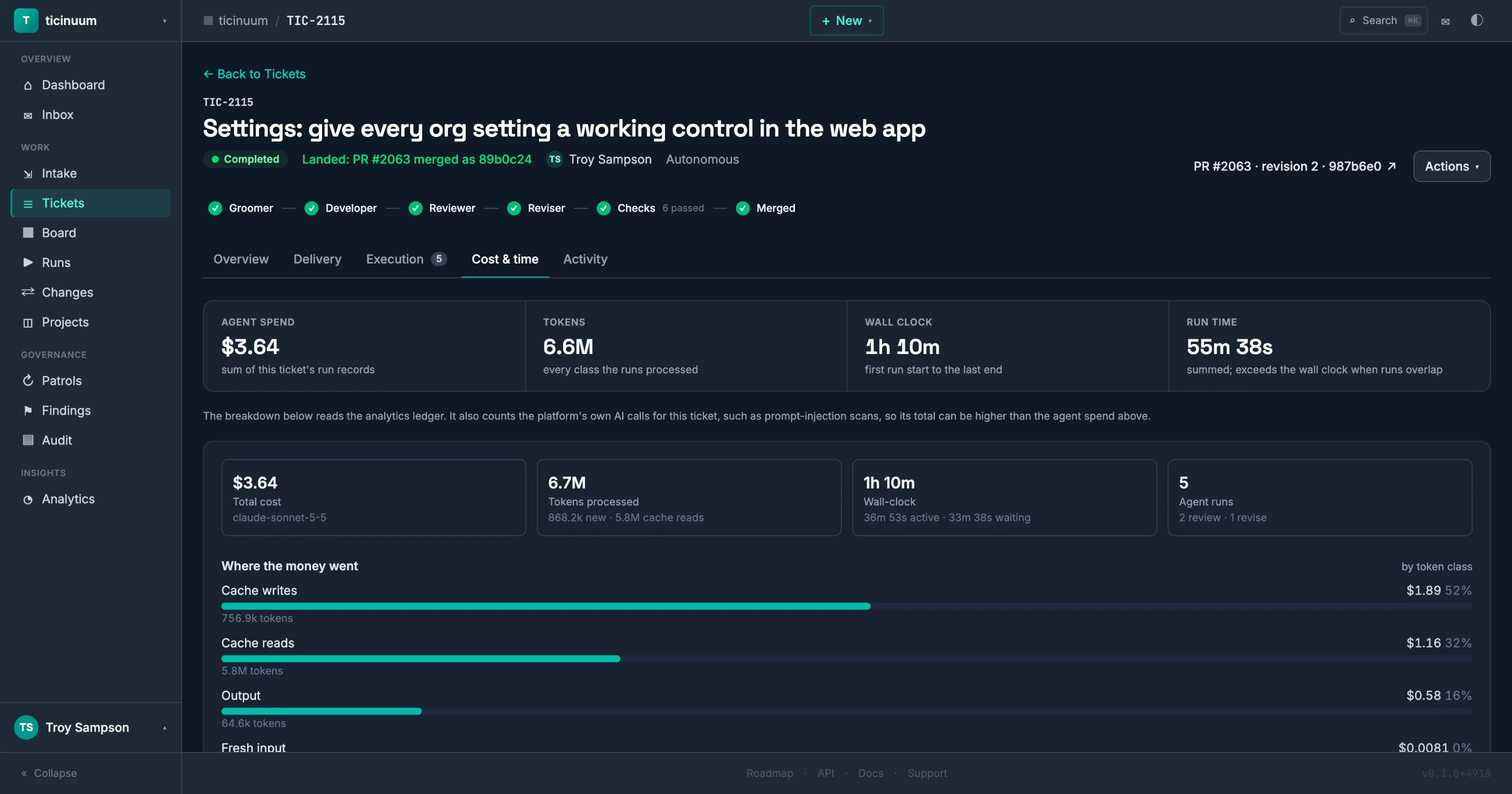
- Configurable per-run ceilings — a token ceiling carried across pauses for human input, and a spend ceiling in dollars priced from real usage, cache reads included. Cross either and the run pauses for a person rather than quietly ballooning.
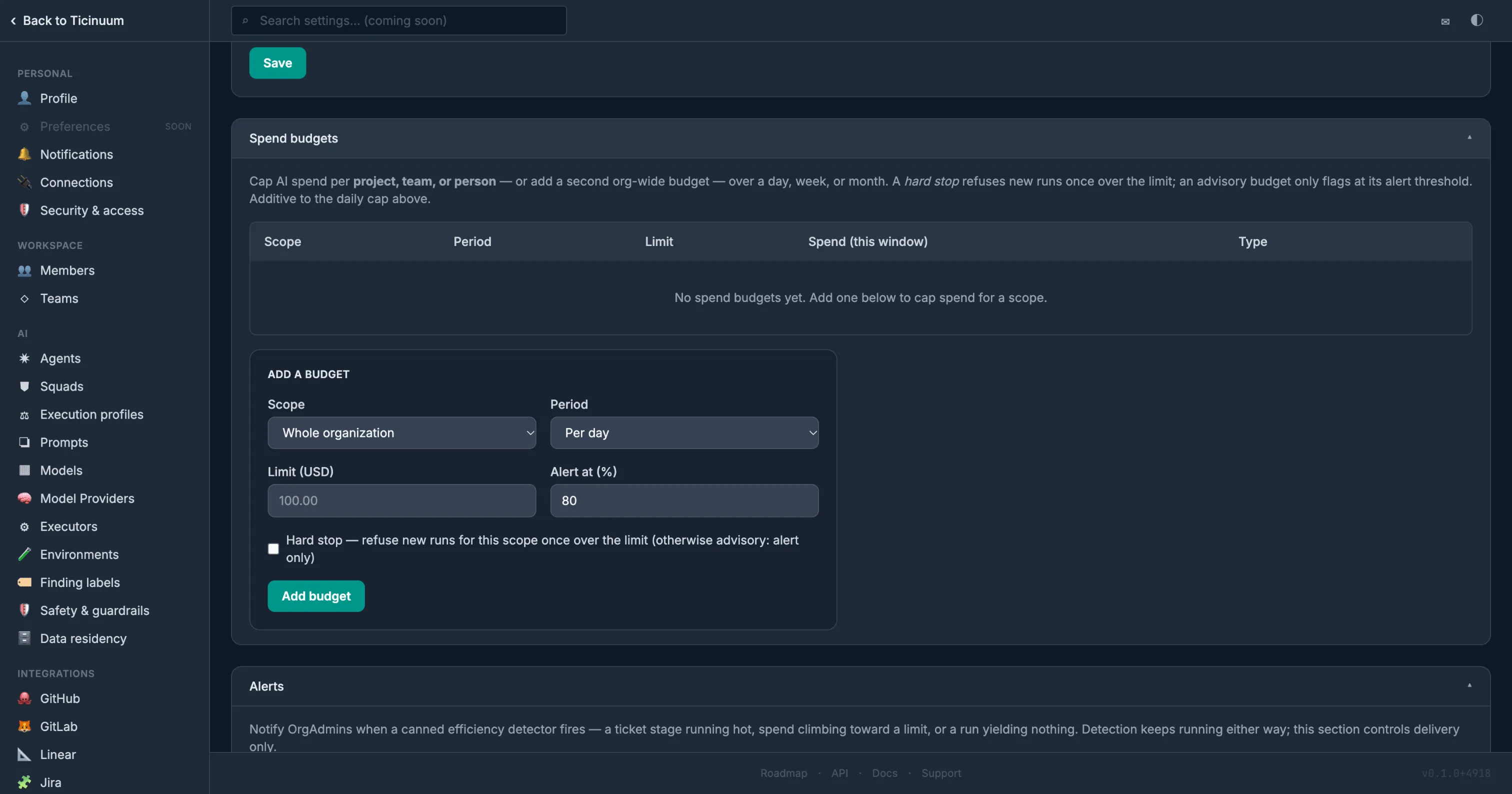
- Budgets where the money is — beyond the daily breaker, cap spend per project, team or person — by day, week or month. A hard stop refuses new runs for that scope at the limit; an advisory one alerts at its threshold. A plan can carry a budget of its own that stops its next step until someone raises it.
- Loops that stop paying when they stop helping — the review→revise loop keeps going only while each round makes progress, and hands a stall or a finding the agents keep arguing over to a person (an optional round cap sits on top). The agent's tool-calling rounds, a planner's ticket count, and a ticket tree's size and depth are capped, so nothing spins or fans out forever.
- Operator hard-stop — cancel a run and its executor sees it on the next heartbeat — the in-flight model call is aborted within seconds; whatever was spent is still metered.
In the product
Captured from the product.
Real screens from Ticinuum’s own organization, taken in October 2026 — not mockups.
Roadmap fence
Cost controls: what's opt‑in, and what isn't built.
What's built but off until you turn it on, and what isn't built yet. Open any row for the whole sentence, or read the whole fence.
On the roadmap Not built yet, or built but not yet validated in use. Don't rely on these. 2 items
Costbuilt · not yet validatedEfficiency & spend stewardship — detectors, alerts and an Efficiency page for time, tokens and dollars per ticket and stage; its known data defects were fixed in early October 2026, but it has not been validated in use — don't rely on it yet
CostThe combined autonomous + workstation cost dashboard — waits on a decision about how to value subscription-funded sessions — today every workstation request is priced at API list rates
Built · opt-in · off by default Shipped, but off until someone turns it on, usually your org admin, on the record. 3 items
Costclaude-local backend — ~$0 subscription-backed execution (reduced: the CLI's own turn and budget limits stand in for the per-run ceilings; it can still ask a person, ending the CLI run with a workspace snapshot until the answer resumes it)
CostWorkstation session metering — an engineer's Claude Code spend attributed to the ticket in the same ledger as autonomous runs, priced at API list rates, with per-engineer spend for an OrgAdmin; metadata and counters only, prompt content never captured
CostFeature economics — a whole ticket tree's cost, tokens, time and outcome, failed attempts included, on the parent ticket, in Analytics and over MCP; every figure carries a fidelity label instead of a misleading $0.00 (the web views are a SystemAdmin switch — the read itself is always available over the API and MCP; the cross-tree portfolio view is not built)
FAQ
Questions, answered plainly.
How do you stop agents running away with my bill?
Independent layers. No build starts until someone asks for it. A global kill switch and a per-org daily budget breaker in real dollars — it auto-pauses the org on breach and fails closed — stop new work from starting, and budgets per project, team or person can refuse new runs at their own limits. Configurable per-run ceilings on tokens and on dollars pause a single run before it balloons, and the review loop stops the moment a round stops making progress. And an operator hard-stop cancels a run already in flight, cutting the model call within seconds.
What do "token economics" and "tokenomics" mean here?
Treating tokens as a unit of cost and a unit of value, the way the FinOps Foundation describes it: metered, attributed, and tied to an outcome. Its opposite is tokenmaxxing — rewarding how many tokens people burn instead of what the tokens bought. In Ticinuum the unit of account is the piece of work. Every ticket carries its own cost from real usage — by model and by token class — and rolls up into the feature it belongs to, so the question changes from "what did we spend on AI this month?" to "what did this change cost, and was it worth it?" Validated efficiency alerts on top of that are still on the roadmap.
The rest of the deep dive
Every other guardrail, on its own page.
- Audit trail Every diff, decision, token, and dollar — on the record.
- Human-in-the-loop Humans approve only where policy requires.
- Security Your key, your quota, your data.
- Data residency Choose what lands where.
- Claude Code & MCP Your engineers' sessions join the record.
- The deep dive All six on one page, with the roadmap and the comparison.
Put your backlog on the continuum.
From intent to PR to review — one durable, auditable continuum of work. Early access opens soon.
coming soon
Early access opens once the waitlist terms and privacy notice are final. Nothing to sign up for yet — this page collects no email.